Thursday, September 21, 2023

The Commodification of Crystals is Stupid (originally published to Medium.com/@abbypeytonlaporte)


The Commodification of Crystals is Stupid

Don’t buy gemstones. It’s bad for the earth, bad for your spirituality, and totally contradictory to the lessons that stones or crystal healing can offer.
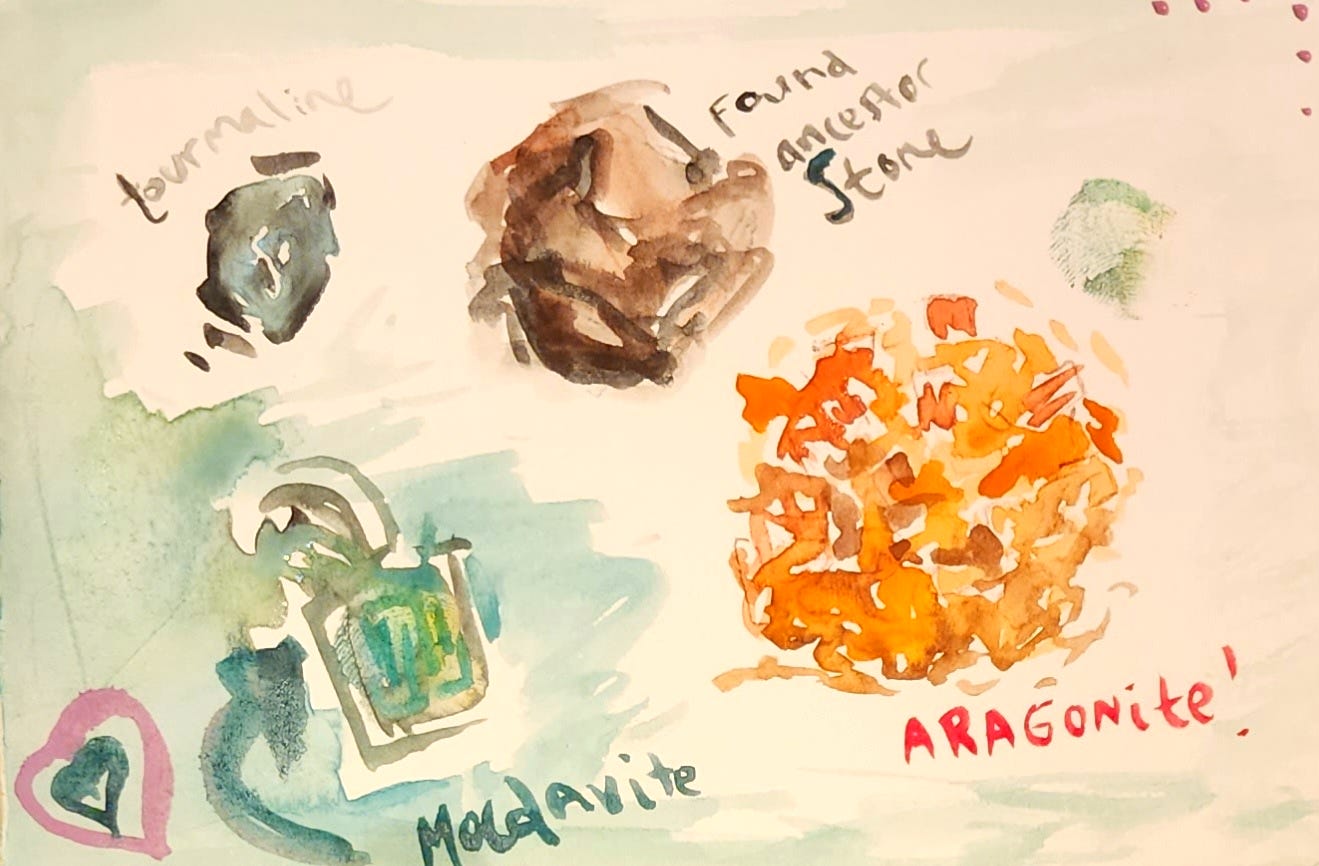
small watercolor portraits by author

When you take plant medicine in ceremony, you first ask the plant, thank the plant, and prepare yourself in a variety of ways for the sacrament. The medicine works on you, mind, body, spirit and beyond, and passes through your system, leaving you transformed.

But then why are sacred crystals from within the earth of Planet Earth itself starting to be treated like plastic jewelry?

If you have ever used crystals in your healing practice (anything from rose quartz, to jasper, to moldavite, to malachite, to even mineral healing such as copper) then you might be aware of their power. If you are trained in Reiki healing, or otherwise practiced and mature in your energy sensitivity, then you know the gravity and seriousness with which crystal or gemstone healing can occur.

The hierarchy of power in any setting is damaging and usually inaccurate. From species hierarchy (which animals we do or don’t eat,) to calling some plants weeds (dandelions are more healing than dahlias, overall,) we are increasingly eager to find lines in the sand. Gems are no different. 

Most people are willing to jump on trends or common belief to just feel safer — mostly so that they don’t have to worry about making additional choices themselves. To give away your choice is to avoid making a wrong choice. This is understandably appealing. Trust the online store selling the crystals to tell you their uses. Follow their accounts to know which crystals to buy more of or to buy next…

Larger crystals are not more powerful. Chairs or large decorations made out of amethyst are wasteful and greedy. If you don’t actively work with your crystals and treat them like family or pets, then you should never, ever buy any more. Until you know and understand each crystal, do not increase the demand and then, as such, increasing the mining of crystals.

If you are going to buy a crystal, you are going to be buying it after it was taken from its home and birthplace, of the dirt or cave or environment in which is was grown, by Planet Earth, over thousands of years. 

Buying extracted crystals (all crystals that you didn’t find on the ground yourself, essentially) is like buying the teeth of mother Earth that have been pulled from her for your consumption. This is an exact and insidious contradiction to the meaning and purpose of crystal healing.

If you want to heal yourself, don’t use the damage of other to do so. Don’t take or steal or buy or commodify any piece of this planet to heal yourself. If you can find a beautiful stone, then pick it up and ask it’s name. Introduce yourself. Feel the stone in your palm, notice its texture. Put the rock or earthly mineral that you found into your pocket. (This also works with pieces of bark, or fallen leaves. Anything that was already available for your reciprocal healing and care.)

Carry it around for a few hours, maybe a few days. Bring it home with you, wherever that may be. Get to know it over the course of months and years. Pay reverence to the pieces of earth that you are asking to help you be a healthful human being upon our earth.

Only ever take a stone from a place where you are allowed to gather stones. Don’t pick up anything from a natural place where you’re not meant to, for the sake of the nature there. Your healing doesn’t mean the harming of another, not even another who doesn’t speak in human words.

If you believe in the powers of crystal healing, then you must believe in your responsibility to care for the crystals you already have. This is as serious as anything else. As we allow it to be true, it becomes true. 

So be the guardian and steward of your already-bought gemstone pets. Be the mother to the stones that you took from your mother earth. It is your responsibility, as a human being. Care for second hand gems, if they happen to find you. Never buy any more new crystals.

No one can heal you if you are harming them.


Further Notes: 
1 (for the crystal healer)
2 (for the influencer)
3 (for the skeptic)


1

To be clear, love and cherish the crystals you might already have. Treat them like wonderful pets or plants; care for their energy like you care for the hair, fur, roots, or leaves of other beings in your home. Tend to them, so they may tend to you. And, just to note, raw crystals and small crystals are sometimes more powerful. Not over-commodified objects, like polished pendants or massive bowls.

But stop buying them. Please, find ways to make your current life sacred.

Find other shiny things. Make non-shiny things shiny. Become shiny yourself and stop looking for more objects or extractions to feel that brilliance. If you want to work with minerals, use a sprinkle of salt. Be creative. 

Or even channel the energy of a crystal you’ve learned about without having to buy it! Write poetry to the idea of the crystal, if you feel called. You can even draw a tiny rendition of a new crystal that you feel could be helpful and imbue it with the healing properties — without extracting it from it’s original home within our only earth. If you want to self-heal, then set your awareness compass to become wise about what health and healing truly means.

Also, (article foreshadowing) test your home for mold. Notice ways that you might be increasing your own daily fog, disorder, and chaos. Quit substances. Meditate. There are so many millions of actions we can take to improve the quality of ourselves and our lives. 

Lucidity, health, and happiness go in waves, particularity within this horrific reality of trading time for survival (capitalism). Acceptance and silent meditation can help. If that feels daunting, find tiny little safe ways to feel a tiny bit better once in while.


2

For creators or spiritual influencers, please stop suggesting new crystals for people to buy. 

Give us more non-consumption based rituals, healing techniques, or tools. 

Give us ways to do better, be better, and become healthier that don’t involve more taking, buying, spending, purchase-hunting, shipping, seeking, owning, and otherwise objectifying this planet. 

Or guide us to talk to trees instead. Or to find living plants in our neighborhood. Seek ways to teach us to preserve, conserve, allow, and breath into the world that we already inhabit, instead of finding more ways to have or add. 

Enlightenment, in a crude summary, includes a clearing away of illusion, or excess, of that of our non-self. So, as healers and leaders, guide us toward that. Base your guidance in compassion and love — not a self-insular need, need, need, and telling us there’s more to purchase and use.

We all already have many, many objects at our disposal. Let us learn how to use our own hands, hearts, creativity, and the world around us instead. 


3

Note: Although this might seem like a trivial or niche topic, the way that we interact with all aspects of our lives is interconnected with our treatment of ourselves, other humans, and our world overall. 

I ask that we consider the macroscopic impact of our more nuanced or seemingly minute behaviors; that is one core reason that I’ve taken the time to write and then decided to publish this article, beyond the topic itself. 

Throw-away culture and objectification (of tools that are also seen as energetically alive!) is just another facet of our disconnection to life and lack of awareness for self and others. 

Deep thinking, lovingness, creative and open minded awareness, and self-wisdom are some primary antidotes to an isolated-topic mentality, in my experience. 

Always be willing and ready to notice missing logical links, and to shift into something more healthy for all beings. 

Find ways to create harmony, health, and congruence, with whatever that might require or inspire.


You’ll do great! No regret, fear, or worry. Only a determined and gentle self love to move forward with knowledge, awareness, kindness, and grace. I believe in your capacity and strength to find creative ways to survive and thrive with the tides of life, even in such a context as this. Let yourself rise to the challenge and create a life that feels wholesome and, ideally, safe.


Further readings:

  1. “Do You Know Where Your Healing Crystals Come From?” 
    by Emily Atkin for New Republic, published May 11th, 2018
  2. “The environmental impact of crystals // not so healing after all…”
    by Gittemary Johansen, on Gittemary.com, September 16th, 2022
  3. “You’re Not Crazy. It’s Really Not Supposed to Be Like This.”
    by Anna Mercury on Medium, published February 27th, 2023
    [This article, despite using the complicated term “crazy,” is a fascinating primer describing why we are suffering to such extremes in today’s world. Not about crystal healing, but about the whole context within which we seek to self-heal, and an overall great read.]

Bonus: 
“Are crystals the new blood diamonds?”
by Eva Wiseman, for The Guardian, published June 16th, 2019

Friday, September 15, 2023

My Existential Fear of Public Writing (originally published to Medium)

 by apl, 2023

My Existential Fear of Public Writing

I stop short when I try to document the content that courses through my mind and body. (Three Part Prose Poem / Exploratory Lit.)

watercolor by author, for this story.

I sit down to write. My fingers freeze.

The currents of analysis is bursting from my brain, like a stopped faucet in need of release.

I can’t wait, leaning forward, hips tilted in my chair toward the screen. I am eager, enthralled and amazed, running hot to get these concepts into the world. Into the world…

Where is the world? Aren’t I just as much of a world as the world itself?

The internet is a non-place used almost entirely to describe the physical realities within which our human existence is located. We join together, from vastly different lives, with disparate data about the meaning of humanness, with increasing consciousness and fear of death, creating and absorbing into a virtual space.

A space with less than two dimensions, technically speaking.

Money. I can’t provide my ideas to the ether for fear of losing them.

I want money. I want money to survive more easily, better, and for a longer amount of time. I expect, with not much evidence, that this money shall be born from these ideas. That my creations are my future wallet.

That my brain is the source of my survival.

It is so much easier to write when comfortable. It is so much easier to do anything when we feel safe. My psychiatrist said that I need to adapt myself to challenges more effectively; that emotional and psychological resilience are healthy and protective factors in psychological outcomes. Or, that’s how I heard it anyway.

My eyes and head remember the feeling of grief. Loss after loss but almost none of them were death. I feel the experience of past elation in my body. I observe the fast undulations of emotional and physical sensation of being human. The rising pressure of having to pee, or not, or hydrate, or not, or get out of the sun, or get into the sun, or stretch, or sit still. These electrical machines of atoms, of cells, attuned to the minutia of being.

We inhabit delicate vessel, from which to create.

And yet we must trust the world to receive the projects and gifts that are born so gently of these vessels; the genius that is sometimes birthed so ferociously from the kingdom of our flesh.

Our minds and thinking and writing seem too often limited by our time and strength.


I write around the concepts.

As usual, I notice the tension of a gnawing desire to express and a deep fear of expressing into nothingness.

Of losing the expression into the abyss. Of sacrificial infant ideas, ready for consumption, afraid of being gone forever. Gone forever like hundreds of Docs forgotten. Like the ghosts of posts past. Like the memories of the money I could’ve made or the lives I could’ve changed.

I sense the internal wave of shivering that I indeed have some time left. I have life left within which to create. That I will probably continue, at least for a while, to survive. Praying to the internet for the spacious permission to create and create and create.

That the void is just a void and that we humans are nothing more than ourselves.

We weave the tiniest of moments into a fragile tapestry of mutual hope.

We seek the memory of our ancient bodies, decomposed. We tie down the sky to keep ourselves from floating away. We are the people of Planet Earth, of Earth’s internet, of the ideas and writing that bring us home to our own consciousness, over and over and over again.

I’m here to create, just like anyone and everyone else. I’ve suffered enough.

Now I want to use that suffering for something. For anything.

I am concerned to the point of stillness of losing my precious, beloved ideas. But it would be worse to lose them by never having offered them at all.


I sit. I write in circles around my greatest ideas. I cage in my fear, like a small rabbit. I let it hop, and sing, and chatter. I feed it carrots. I notice the rabbit pray, small paws like a mouse. A mouse that shimmies into the warm and protective palm of myself.

Last night, I dreamed of a nestling mouse.

The cutest, most puppy-like mouse I had ever seen. Then, something terrible happened. But I pray for her, dipping the idea of the tiny creature into the ether, alongside my writing. Loss is a myth. The mythology of death. We are just big stars crunched up into smaller bodies.

The mouse is just a symbol for the rabbit of my fears.

The sad fate of the mouse, which I shall not write here, is just homage to my deep caring, my small heart of compassion for the writing. For all of our writing. For the humans that, so small in this galaxy, continue to pull from the fabric of the cosmos, into consciousness, as we create, create, and create.

We are nothing against the backdrop of possible bravery.

So, as always, I will not forget to create. I will not stop myself. I will ride the tides of fear or sorrow, and dive into the black water of the deepest oceans. I will pull up fishes and pray over them; water into water, with a shimmer into the sky.

I will soothe lost beach mice along the shore. I will write my ideas privately, and consider their lifetimes. Where will these ideas live, if not in the possible awareness of other human beings through the portal of our virtual realms? Where can I place them?

Ideas so delicate, like living beings, ready to scamper toward the bright shores of existence beyond just me.

Photosynthetic ideas, like underwater algae, breathing into the symbols of lifetimes beyond me. Giving energy into the ocean, available nutrients, awakening over the course of time.

I want to offer my mind to the future. I want the future to offer abundance to me.

Thursday, September 14, 2023

Into the Broken Snow Globe / / A flash autofiction description of physical pain, medical experiences, and past eating-disordered-behavior. →[content warning]←


Into the Broken Snow Globe

A flash autofiction description of physical pain, medical experiences, and past eating-disordered-behavior. →[content warning]←

photos of author (left to right, taken in 2011 & then 2023)

When I first felt the searing of shin splints, I was hobble-sprinting toward a dance class in below zero weather. I was about 95 pounds of ballerina, cold, and in pain. Tears were dusting the icicle of my sharp little face. I felt very, very frustrated to be so very incapacitated by who knows what.

It began when I was born. Obviously. Or, maybe it began in utero. 

Or maybe before that in the cosmos, as some sort of angelic being that decided to suffer for the sake of learning. But that’s pretty much how every single story in the history of humans begins, which you also already know.

So I was hobble-sprinting (TM) like a lonely leprechaun, at only five feet tall and with almost no physical health left in my body. I was searing, burning, and angry, but also urgently sad. My heart ached for a change — any change — to something easier. Anything, really, where I wouldn’t have to suffer every moment of every day.

At this point in time, I was more comfortable with a toothbrush down my throat for no reason at all than I was with my boyfriend, or with a nighttime spliff of weed, or with my delicate and strained shin bones and lifted tibias. I was sick of everyone, but especially sick of myself. Sickness seemed easier.

I got to ballet class 7 minutes late, which was four minutes too late to get credit for that day. I wasn’t really much of a ballerina. I was, more so, an 18 year old biology major who needed a physical education credit. It was part of the general education units that I did not want. And also a near-cliché aspect of my childhood extracurricular history.

Did the toothbrush comment feel abrupt? Part of the conundrum of being a limping dancer with medical problems galore is that I lost a great deal of my human compassion. My selfishness increased with my pain levels. So, basically, I don’t have enough energy to consider your personal history of eating disorders or not. I should. But at least I’m aware (and telling you directly) that I don’t.

I danced while crying. Small, small tears until later, after class, at which point I began to silently sob. I hid into the crevice of a wall within a behemoth chrome arts building. The facility felt much more elegant than my emotions. 

That large metal architecture held all of our emotions. The other dancers were not unlike me. Different injuries, different salt levels in their tears, different mothers on the phone with varying levels of narcissism or kindness (rarely both). 

The dancers all had different boyfriends or fuck buddies, or girlfriends, or lovers, or friends. Or crushes on professors. Or obsessions with essays. We all had different levels and details of social prowess. I was an extra-social-ballet-focused-student with a boyfriend on the basketball team and a burning brain. A girl with a need for eyeglasses that I hadn’t let myself wear since 4th grade. 

Who was, up until the hospital, actively acing her core genetics lab. A paradoxical yet surefire sign of a soon-to-be inflamed brain, born of an increasingly unstable mind.

As the Vivaldi played, we tripped, fell, and quietly compared our bodies. Or, mostly it was me who tripped and fell. I have weak ankles and flat feet, which should normally dissuade any continuation of classical dance. Apparently not. I had dance in me and it wouldn’t let go. It held onto my heart like the tension in the skin of a drum.

The leotard squeezed onto my nothingness. The tights made my skin itch. Clean tights are best, but my body still doesn’t like those much. And the feet. The angry, aching, amber-red feet. Plus the shins, plus the mind.

I held them inside of me. Hugged them into my soothing soul, pulsing with empathy for the plight of my insides. 

I sensed that I wasn’t the only human existing in this gritty and gutty world of silent suffering. My pointed toes pushed downward into the glassy wooden floor of the studio by the tragedy of not knowing who else. How many of us were there? I wondered how to find them; how to help us all.

As an active anorexic [ED-NOS, according to Kaiser Permanente California Medical Center,] one glance downward from another dancer meant the world to me. My heart would flutter at the smallest moment of jealous eyes touching the non-curves of my disintegrating frame. Weakness, however fraught, was beautiful to me. That is to say, only true frailty could express the level of rage I held inside my collarbones. 

I twisted the rage around my bonesome fists like a rope. I felt it inside my sore eyes. The fury lived inside of the viscera of salted memories, housed near wounded flesh, an existential gnawing toward my terrorized child within. (An inner child who is now safe and loved. She’s here, with us, writing this story, as an adorable aspect of retrospect.)

The girl danced, a hypermobile ballerina from Petaluma, California. A girl who sure knew how to win.

The ligaments didn’t make sense, technically speaking. Neither did the joints or tendons. But, luckily, I avoided the doctor. My body could pretend to be normal for as long as I needed; this cost me the price of my mind.

 Without getting into it, the psychiatric expense was just about the size of my destiny.


I walk out of Kaiser, now 31, like a spy. The man in the physical therapy department has helped my poor, poor feet more than any doctor ever could. I praise him and feel like I’m going to cry. 

He calls me to follow up. I thank him five more times. When we get off of the phone, I actually do cry, overwhelmed by gratitude and the humanness of it all. Technically, he didn’t actually help yet, but the suggestions felt distinctly helpful.

I sit on the bench under the sun that they only provide at the offices in my hometown. Back home, still or again, at 31 years old. That’s what that glamorous eating disorder stuff will get you, kids, so don’t do it. It was one thousand times over not worth the subsequent suffering. 

Really, it wasn’t even worth the suffering of the times of fasting themselves. Living through self-induced torture felt like a disgusting and strange way to be. The anguish of repetitive fasting wasn’t physical; it was a high and an addiction. I was getting a fix of weightlessness. 

But the superficial and enraged obsession with smallness created a type of existential shame that I hadn't otherwise encountered.

I open my Chromebook as I wait for the pharmacy. The pharmacy closes as I write this, dramatically, so I’ll wait for the bus instead. I gently complain to the guy behind the pharmacy door. The hot younger security guy offers to open it for me. I decline, partially because I’m nicer now, but also partially for the theater of it. Both motives feel just fine.

The older man who closed the sliding glass doors comes over a while later, after everything’s locked up and the coffee cart is inside, and softly apologizes to me, too. He commiserates. He even adds in how much he dislikes Kaiser. 

I thank him for being generous and reassure him that I found out later that they ran out of my mood stabilizer anyway, so he doesn’t need to feel bad and it was entirely alright all in all, and that I hope they can still change the pharmacy for pickup and he suggests the app and then he does prayer hands and gives many smiles in a row and I put my computer away and walk toward the bus stop.

I experienced the thrill of non-ceremony degree conferral earlier this summer. It was a balmy July while staying with my Aunt in Rhode Island. That day, I could practically feel the paper passing through the hands of the dean to be signed on the other side of the country. Dominican University of California, Masters of Fine Arts in Creative Writing with a Narrative Medicine Emphasis. 

I sit quietly with my past child self at the bus stop that day. We are in the September sunshine. I am illuminated by the California air, correcting my posture for a recent crook in my neck. 

I get to listen to the worries of this little girl, of seven-year-old me, a figment of self-therapeutic practices and maybe spirituality. I comfort her, I comfort me. She asks questions, gives me encouragement. I sit and breath and meditate. We become myself, merging into a nice timeline of a non-ballerina. We sit, and hold the crazy 19 year old young woman in our arms, on each side with her between, melting the icicles of the insides of her mind. We give her the sun. The bus arrives. I smile at the driver.

He says, “I’ve never seen someone so happy for the bus to arrive!”

I’m the only one on the whole bus. I laugh, smile, and thank him.

“Well, I mean… I’ve been waiting a really long time and I’m just glad you’re here!”

The little girl of my past self doesn’t leave. We sit in the middle of the seats, alone and together on the bus, child and adult. In the golden hour, I take a photo of myself, smiling. I am a little less than 200 pounds. I feel happy. I feel safe. I feel healthy. I am beautiful.

I am here. I am human. I’m me and I am alive.

Growing Up Lana by apl in september of 2023 (originally published to medium and to writings section of abbypeytonlaporte.com)

Growing Up Lana

A story of 2011 Lana fandom, losing my mind, regaining my sanity, and then going crazy once again — all to the syrupy, near-operatic soundtrack of Lana Del Rey.


original photo by will anderson, blurred by author (on the right)


This is a chaotic personal essay. 

[Content Warning: mild descriptions of psychosis imagery / SMI symptoms]

_

When I first heard Lana Del Rey, I was about 19 years old. The year was 2011. Her first full-length album was released in June of that year. By June of 2011, I was either on the precipice of psychosis or just recovering. The timeline of Lana’s music is factually more clear and better recorded than my history of psychiatric hospitalization.

The first time Lana influenced my life was a few months later. I had become entirely obsessed with Born to Die (the album) and was in the middle of delusions and hallucinations — 

(REAL delusions, not the TikTok appropriation-plus-entitlement, ablest meaning of delusions). 

I was sobbing in my mom’s bed, with her trying to understand what was going on, frantically placing damp cloths on my face, while I slid further and further down toward the floor (literally). It was 2:00 AM and I was wincing, yelling, snotty, and choking. And, most importantly, to the core of my being, I thought I was being physiologically and interdimensionally transformed into the newest pop-icon that was 2010s-style Lana Del Rey. 

I could feel my eyelashes growing into false lashes. I could feel my skin, blood, and muscles changing into hers. The physiological transformation felt like a gooey caterpillar in a broken, yet somehow moldy cocoon. I started thinking about the stress of tour dates. 

I wondered why they had to replace her at all; why they had chosen me, specifically. I wondered what kind of cosmic overlords were giving themselves access to my physical body, just to replace the dreampop sensation of Lana. And, about how I would actually miss the real Lana, as her fan. But, I was also secretly enthralled and energized to become her AI robot-human covert sleeper-replacement (… the AI thing was a side delusion). I mean, I was supposed to be crying — that’s how the false lashes would sprout! Obviously!!!

Could I tell anyone once I’d lost my own body? Did my mom know I was disintegrating? Did I also look moldy??? (For context, this was between hospitals, during a relative lull in the symptoms.)

The next time Lana Del Rey impacted my life was when I was first began having time travel dreams. 

In my experience, you can’t be delusional or hallucinate in your dreams. In fact, at least for me, the physical brain injury that can happen in prolonged, florid, and initially treatment-resistant psychosis, meant that I did not dream at all. I didn’t dream in the hospital, nor in recovery, nor when I was first starting to read again. 

But, I most definitely dreamt between it all, and afterward. And those dreams involved timetravel. A lot of timetravel. Romantic, terrifying, important, dramatic, and also very esoteric psychedelic-rock timetravel. But also, like, truly world-saving timetravel. Don’t ask.

Until then, though, I slept in a shade of dark grey. The lumpy nothingness of sleep in the psych ward in psychosis was somehow heavier than anything else. So, in the time of my dreams returning, I began to over-associate with the lyrics of her album. Specifically, the titular song, Born to Die.

I knew that my future husband, my partner, the man with whom I could reconcile the ills of the world, was perhaps already dead. Or that he had never lived yet, or that, “Every time I close my eyes, it’s like a dark paradise. Nothing compares to you. I’m scared that you, won’t be waiting on the other side.”

I screamed, cried, went wild-eyed thinking about him, about this made up man. I knew that Lana knew. Sometimes I thought she was me, I was her, or that we were both telepathic. 

Sometimes I thought that she merely was the messenger, delivering crucial truths from god, the gods, or perhaps the devil himself.

When Lana next spoke to my malady-minded yet societally-privileged soul was upon the release of Blue Jeans, in 2012. I was recovering from the first 9 weeks of locked unit hospitalization and closer to 6 months in and out of symptoms, with another year spent in residential psych treatment. 

But please, please understand — my background of relative financial privilege, which allowed me to receive so much treatment, plus my dogged and unquenchable desire to survive and thrive, comprise a set of blessings that now allow me to live and write, currently-able-minded, over a decade later. And to hear music. To still hear music. To even so far as remember hearing music, and it’s meaning, at that time in my earlier life.

I was slowly and dully recovering, staying with my dad at an apartment after their divorce. The divorce was completely unrelated, but began a few months prior to my first psychotic break, arrest, and then 52/50 involuntary hospital holds. 

It was, all in all, a probably almost-unbearable-situation for my precious little brother, who was 17 years old when the various crises started. He was set to live alone with my parents (as they fell away, in starts and fits, with me, insane or recovering) throughout his senior year of high school.

Lana couldn’t solve my younger brother’s trauma, but she definitely could sing me into a whole fervor while I sat, waiting to become more and more sane. Shoutout Zyprexa, Abilify, Lithium, Latuda, Geodon, Risperidone, Seroquel, et al.

At that point, the best guess of the doctors was schizoaffective disorder, but that was only after the could get me back from catatonia. (In my case, psychotic catatonia showed up as a coma-like state, for about 48 hours, much of which I was totally alert but couldn’t speak, move, or open my eyes. They felt glued shut.)

This isn’t a complaint. I’m absolutely and totally glad to be alive. I’m obsessed with the idea of redemption, of becoming helpful in society instead of having simply taken up a bed at the ward.

Luckily [was it luck? or the other side of injustice? oppression that benefited me indirectly as the categorical oppressor? was it randomly assigned? was it a template for what every human being should have the structural ability to access, unequivocally and irrevocably, as needed?] I had the ability to get help paying my medical bills. 

I was — in some twist of contemporary, problematic, but also life-saving fate — able to leave the hospitals debt free, and with the further possibility of more medical treatment.

I would put in my headphones, still corded, and chant her music like hymns — like invocations. Like whispers from Aphrodite as I learned how to be understood. I would cry with her, laugh with her, sing her to the moon, new and full. I would puke with her, starve with her, eat with her, get sick with her. I would smoke weed with her. Quite weed with her. Go back on my meds with her. Yell in the streets for, with, and from her. Lana, for better or worse, carried me on the back of her melodies and lyrics, for the years between the hospitals. 

Just over one year later, I turned 21 in the psych ward. Back again. Again, more meds, again, raving lunatic. Again, afraid to die, born to live, and re-learning how to survive.

There was no music in the psych ward at that time, which is fine. When we watched The Hunger Games, I thought we were being prepared by the Alta Bates medical staff to be sacrificial humans, for fights to the death against other hospitals’ patients, in the wide streets of Berkeley, California. The apocalypse was nigh. 

Lana did not need to be connected to that part of the journey, for anyone’s sake. 


One movie was already too much input, let alone the idea of accessing albums worth of melodramatic lyricism and mild camp aesthetics from the United States 2012 Sad Girl delegate.

I am sane now. I still sometimes listen to her. She became problematic (or, already was, but we found out,) then received societal redemption, released more albums, collaborated with The Weeknd on Stargirl, rewrote her family backstory, had a totally resurgence with the youth, happened on TikTok, got thick (which is the healthiest possible thing to happen for little girl’s body image in the history of Americana Pop). 

She became an obvious adult, turned 36 during the pandemic, released weirder and more fun albums, embraced an updated 2020s sound and samples, added a Tommy Genesis collab, and, most recently, got engaged to a somewhat normal-seeming music producer — and played at San Francisco’s Outside Lands 2023, with iconic girls putting iconic flowers in her hair, while sitting in an antique makeup chair in front of a massive vanity mirror on the Lands End stage. 

Full circle, full quirky, and full-figured. Lana was redeemed as I was. Lana is a grown adult like I am. Lana is fun, successful, and appreciated by the youth demographic of consumers, as I shall be too one day (loll). A template of theatrical womanhood. And possibly performative adulthood. For now.

So, ultimately, I’m not so sad-girl that I followed Lana this far. I am glad to be human, glad to be alive, glad to have survived, and now, extremely happy to be an adult in my early 30s, that can think. 

Growing up Lana has felt complicated, but so has life. 

Growing up in itself, overall, is one of the greatest blessings beyond my wildest imaginations, traumas, or fears. Getting older is the all-time greatest gift that I never knew I would receive. And, quite frankly, I am glad that Lana could join me along the way.

So yeah. Now, my brain works just fine. That is the most magical blessing of all — no matter the soundtrack behind it.

_

follow me on medium: Abby Laporte

or my website (....here....)  at www.abbypeytonlaporte.com 

Sunday, September 10, 2023

The Basics & Benefits of Self-Awareness (as originally published in full on medium.com/@abbypeytonlaporte)


The Basics & Benefits of Self-Awareness

A mildly literary description of building self-understanding (and why it’s hard but good to do).


Self-awareness is like a romance. Elusive, exciting, ever-evolving. We don’t know how far to tap into our self knowing, but we know that we want it. The feeling of self-awareness is both awe-inspiring and entirely terrifying. 

To understand who we are with increasing objectivity is a part of time passing. As we grow up and gather experiences and data of all kinds, we generally learn who we are with increasing accuracy. Unless, of course, you can’t stand self-knowing and drink or scroll or gossip or zone out instead. 

Or, worse yet, if you think that you enjoy developing your sense of self but actually don’t. So you disregard the hints of friends and therapists and journal out things that, perhaps, aren’t as true as you want to believe. You meditate upon false concepts of self and brag about the wrong things at parties.

Or, ideally, you are someone who cares about being good in this world, and about being good to yourself, too. You want to have clear awareness of yourself. You want to create an accurate yet changeable knowledge of your identity and your presence. 

So, you don’t fixate on yourself. Instead, you allow in real information and catalog it, consciously and unconsciously, with efficacy. Then, you apply that information to continually iterate upon your life and way of being as needed.

And we cannot disregard the strange crux of self-awareness: the point of view. Objectivity is a complicated term for this idea. What’s more, the idea of perspective is muddy, convoluted, and quite often almost painful. 

The torrential rains of external data and the thick layers of compacted dust of details that make up our internal identity meet at the ground of our being. The image of who we are among fellow humans becomes clouded and obscured, caked with its contradictory substance. So we build up a more flexible picture of ourselves and hope for accuracy.

Lastly, we can observe our relationship to ourself and, perhaps, to something much greater. This final aspect of self-hood and self-awareness is the most philosophical, and has been widely described or identified by ancient figures, religious leaders, and contemporary thinkers. The relationship to ourself is often reflected in our relationship to all of existence, nature, or the idea of God. 

And, just as we interact with the natural world or spiritual concepts, we interact with our own nature — with the internal experience of being within ourselves. Although we might displace our love or frustrations toward ourselves onto something greater, we still feel the feelings of inhabiting our own body and mind. 

When we really notice the truth of this self-relationship, we may feel things like reverence, self-pride, self-compassion or love, fear, joy, anger, and far, far beyond. This internal emotional, mental, and physical experience is intricate like any other, but also often ignored or taken as a bland fact of reality. 

When in meditation, many find this experience of self-hood to be exactly the same as all other humans across time, beneath the details of self-concept or identity. But that is only one perspective and we all must find our own. Even if we try to avoid knowing ourselves entirely, then that, in itself, becomes the experience.

Yet, we all have these three components: relationship to awareness, relationship to society, and relationship to self or existence. 

Our self-ness shows up in all three. And our awareness or lack of awareness drastically influences the experience of all three aspects. So, we must fight the very human impulse to shy away from ourselves and our self-awareness. We must bravely commit to learning about exactly who we are and how we change over time. This can be a retrospective process, too.

But more often, as we live through each moment, we notice the history of past moments like an unpredictable tide, ebbing and flowing in and out of our consciousness. And, I’ll add, we must understand that the unconscious mind is vastly larger, greater, faster, and more comprehensive than what we can consciously “hear” within. We must give our unconscious permission, as such, to gather data well. 

We much consciously understand the loving benefit of allowing ourselves to self-see from within.

Then, we can let the program run. We can accept that we have set forth the instructions to learn ourselves, and notice when it works. We can release the reigns of self-fear and ride bareback through the forest of an expansive view. 

We can throw down our weapons and pick up our friends and family. We can hold our own hand, the hands of others, and the hands of the truth, too. We can accept the process of self-discovery — for it is only through self-discovery and awareness that we can truly accept the experience of being human and, as such, embrace the reality of being alive.


_

Sources of Inspiration & Their Creators
(… and how they contributed to my understanding)


Say What You Mean: A Mindful Approach to Nonviolent Communication

by Oren Jay Sofer
(Say What You Mean is a book about interpersonal communication, which inspired me to see the ways in which self-awareness can become a massive asset, and all the ways that I hadn’t yet considered the task.)

To See Ourselves as Others See Us
by Michelle Scorziello
(This Medium article uses a similar style while talking about visual self-knowing. Michelle’s writing for this allowed me to realized that I can discuss philosophy in a way that feels warm, literary, and linguistically or emotionally interesting, rather than just rote analysis. That giving concepts life is exciting and, also, a totally smart and acceptable thing to do.)

On Self Awareness Without Change, Toxic Spirituality, & Chasing Spiritual Insight by jaqueline winkler (or, hood.winkler on Instagram)
(This TikTok video from Jackie was massively helpful for me and definitely significantly inspired my writing of this article. The premise, from my view, was about actually applying self-knowledge, rather than just wandering around looking for more.)


If you want to keep up with any new postings outside of Medium, please feel welcome to:

Request my (very new!) author account on Instagram
Or check out my website / blog or donate at www.abbypeytonlaporte.com